There is a term for great outcomes with minimal effort, of which founders, their investors and their accountants are very fond: capital efficiency. And becoming more capital-efficient is, of course, one of the defining goals of any scaling company. It increases the market value of the enterprise you are growing, and it gives you more optionality when deciding what to do and build next.
Do you, like me, appreciate that building a capital-efficient organisation is something to be proud of? In that case, I have something quite disappointing to tell you: efficient allocation of capital will only ever be half the job.
A successful business is a combination of efficient capital allocation and myth. Highly capital-efficient businesses, suffused with the latest technology, cannot afford to dispense with their stories and lore. Quite the contrary: these businesses need myths the most.
Read this excerpt from a New York Times story taking us inside Carloway in the Outer Hebrides, one of just three mills in the world allowed to produce certified Harris Tweed. The journalist, Ginanne Brownell, is interviewing 76-year-old employee Donald MacArthur about how the tweed is made:
It takes about four weeks to produce 50 meters of Harris Tweed, from start to finish […] Once at Carloway, the wool is washed and then dyed, a process that takes four to eight hours. “And that’s where you get the expression ‘dyed-in-the-wool,’” he said.
This is an organisation heavy with myth. It produces a rare and beloved fabric using centuries-old processes; indeed, those techniques have spawned phrases we use everyday. (’On tenterhooks’ is another.) The tub used to wash this mill’s wool was made in 1812.
However, it has faced innumerable struggles in its centuries in business, and was recently converted to a non-profit enterprise.
There is something like an inverse correlation between capital efficiency and mythology. Highly capital-efficient businesses can fund their operations, with significant surplus, from the revenue they earn from their customers. The more capital efficient a business is, the less it needs to rely on mythmaking and storytelling to win admirers and grow its revenue. To its leaders and communicators, they no longer need new stories.
But there are exceptions. And these are some of the most interesting businesses in the world.
Apple is a highly capital-efficient business that nevertheless has a significant degree of mythos. Its flagship product, the iPhone, was arguably the single most important catalyst behind the astonishing global technology transformation of the last 20 years. Its products have built their own mythology.
But it's worth dwelling on why Apple is exceptional. Apple’s many product innovations are only part of a wider story. The human elements of Apple’s history have turned customers into fans. The ‘original odd couple’ of Wozniak and Jobs. Black turtlenecks. Jobs’ own premature demise. The books; the Hollywood biopics.
Clearly, Apple went through extraordinary convulsions to become the mythological corporate beast it is today. My suspicion is that for most businesses, inculcating mythology will have several beneficial effects for their revenue. Giving people stories that inspire them and create a feeling of kinship engenders loyalty and familiarity; they’ll be less likely to switch to a competitor, and you’ll be remembered more quickly and more often.
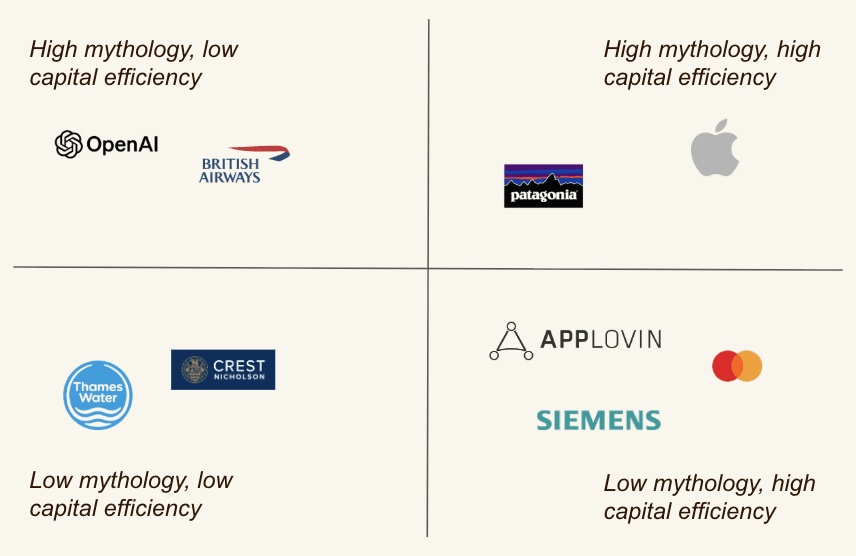
But revenue isn’t the same as efficiency, and it’s definitely easier to create myth in some industries than others. Nevertheless, I’ve tried to apply a rudimentary grid to this heuristic, drawing out some examples:
Of course, the usual caveats and qualifiers apply:
Patagonia is less capital efficient than Apple, obviously, but it’s capital efficient for a retail business.
OpenAI is currently very capital-inefficient, but there’s always a chance that could change.
Software, right now, is undergoing real ructions as markets try to understand what AI might do to incumbent business models. But the big software companies are still, as of February 2026, super efficient businesses. (Just look at AppLovin’s latest quarter: revenue up 66%, stock down 18%. I don’t often feel sorry for CEOs, but that doesn’t seem like a great reward for a stellar three months…)
Now, startups don’t really fit into this grid very well. Here, the average startup would probably fall into the ‘low mythology / low capital efficiency’ bucket, alongside utilities like Thames Water, given that most early-stage software companies operate at a loss.
However, a VC funding model is very different from a mature, debt-heavy capital mix. Equity investment is fuel to test and scale quickly, and ‘efficiency’ in this context should perhaps be viewed as how rapidly the startup is able to test concepts, iterate quickly and pivot when necessary.
But most early-stage companies also fail to build a mythology. I’ve used OpenAI as the paradigmatic example of a company that has developed a mythos even as it has scaled in, prima facie, a very inefficient way. You’ve got board shenanigans, ethical dilemmas, a charismatic and evasive CEO – so much drama in so little time.
Strikingly, OpenAI’s very inefficiency has become part of its mythos. The tech ecosystem, media and even governments are now paying keen attention to the plates Sam Altman and his team are spinning, trying to work out whether OpenAI’s revenue growth will compensate for the capital commitments it’s accumulating at such startling pace.
Is OpenAI a money machine with an LLM attached? Or is it the greatest company of the next 20 years? If it does become Apple-esque in its margins and efficiency, it would represent a metamorphosis that undoes all our assumptions about how companies are meant to grow and succeed. Uber on steroids.
It’s a compelling tale, though, and we should never underestimate the power of those stories.
For startups without an infinite supply of investors’ capital, the challenge is trickier. But consider that you will always have one audience who is keenly aware of how you’re doing, and usually wants you to succeed: your customers.
How are you building a sense of kinship in how you communicate? Are you talking about product updates? Or are you talking about how your customers’ businesses are changing, the problems they’re facing, and how you’re designing the answers? You never know: in this economy, a good enough story might beget a more capital-efficient business. (Try selling that one to your bankers.)